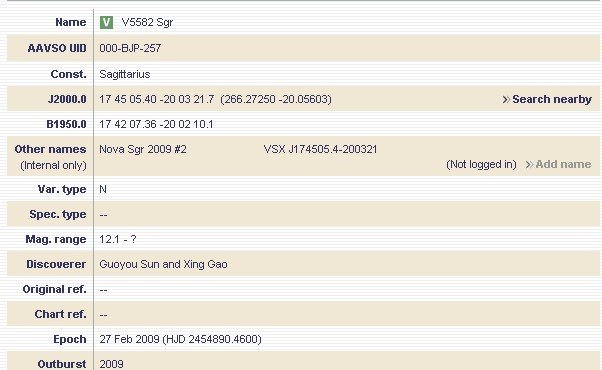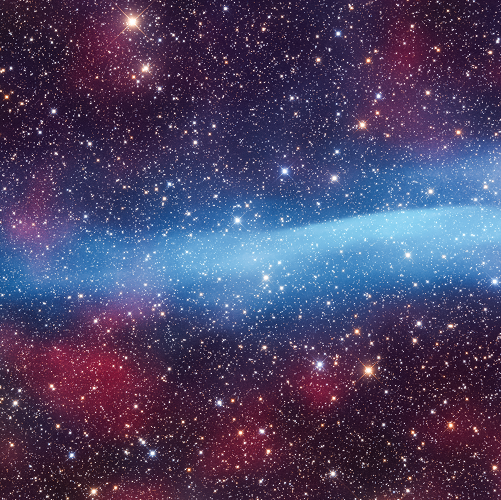
发现时间2009年2月23日,编号V5582 SGR(系中国发现的首颗银河系新星).
新星V5582 SGR发现纪实:https://sunguoyou.lamost.org/v5582sgr.html 发表于《天文爱好者》2009年第7期。
相关图片
国外爱好者确认图片:
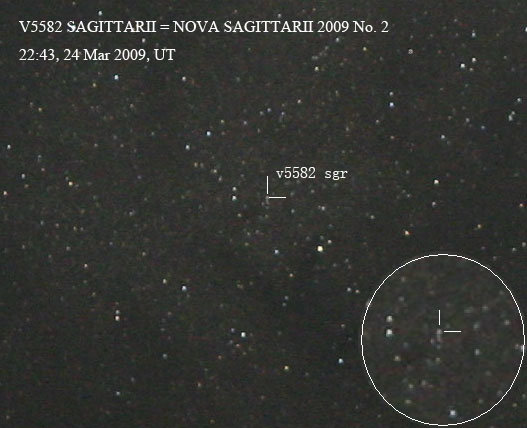
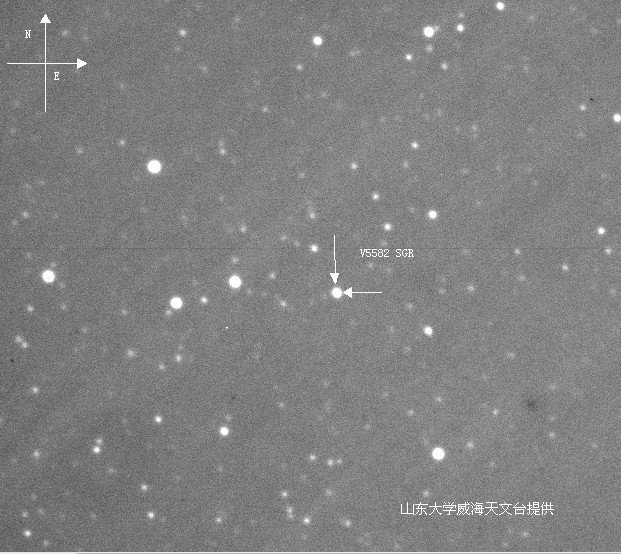
山东大学威海天文台,1米望远镜,确认图片:
CBAT 1816确认报告:
Electronic Telegram No. 1816
Central Bureau for Astronomical Telegrams
INTERNATIONAL ASTRONOMICAL UNION
M.S. 18, Smithsonian Astrophysical Observatory, Cambridge, MA 02138, U.S.A.
IAUSUBS@CFA.HARVARD.EDU or FAX 617-495-7231 (subscriptions)
CBAT@CFA.HARVARD.EDU (science)
URL http://www.cfa.harvard.edu/iau/cbat.html
Central Bureau for Astronomical Telegrams
INTERNATIONAL ASTRONOMICAL UNION
M.S. 18, Smithsonian Astrophysical Observatory, Cambridge, MA 02138, U.S.A.
IAUSUBS@CFA.HARVARD.EDU or FAX 617-495-7231 (subscriptions)
CBAT@CFA.HARVARD.EDU (science)
URL http://www.cfa.harvard.edu/iau/cbat.html
V5582 SAGITTARII = NOVA SAGITTARII 2009 No. 2
Guoyou Sun, Wenzhou, Zhejiang, China; and Xing Gao, Urumqi, Xinjiang,
China, report the discovery of a possible nova (mag approximately 11.5) on
several 60-s survey images (limiting mag about 13.5) taken by Gao in the
course of the Xingming Nova Survey (Mt. Nanshan) on Feb. 23.947-23.963 UT
with a Canon EOS 350D camera (+ 135-mm f/2 lens at ISO 800). Using a
10.7-cm f/2.8 camera lens, their images taken during Feb. 27.96-Mar. 6.97
yield the following position for the variable: R.A. = 17h45m05s.42 +/-
0s.12, Decl. = -20o03’22”.0 +/- 0″.6 (equinox 2000.0); an image obtained on
Apr. 28 by Sun with a 1-m f/8 reflector at Weihai yields position end
figures 05s.40, 21″.5. Nothing was visible at this location on images
taken by the discoverers on 2008 Aug. 23, Sept. 4, 25, and Oct. 3 (limiting
mag presumably also about 13.5); they report that nothing is visible at
this position on Digitized Sky Survey images from 1950 June 19 (limiting
red mag 20.0), 1980 Aug. 2 (limiting infrared mag 19.5), and 1991 Aug. 2
(limiting red mag 20.8). Additional available magnitudes from Sun and Gao
for the variable: Feb. 27.960, 12.1; 28.968, 12.0; Mar. 2.963, 13.0;
3.964, 12.8; 6.968, 13.1; 22.949, 11.6; 26.950, 12.1; 27.947, 12.5; Apr.
28.837, 13.2. The discoverers have posted images at the following website
URL: http://www.xjltp.com/XM09AA/XM09AA.htm.
Following posting on the Central Bureau’s unconfirmed-objects webpage,
other observers have reported their observations of this variable. K.
Nishiyama (Kurume, Fukuoka, Japan) and F. Kabashima (Miyaki, Saga, Japan)
report (via S. Nakano, K. Kinugasa, and H. Yamaoka) the following magnitudes
from their CCD frames taken with a patrol camera (+ 106-mm-f.l. f/4 lens;
limiting mag 12.9-13.8) in February and with a 40-cm reflector afterwards:
Feb. 20.855, 10.9; 25.847, 10.4; 28.859, 11.4; Mar. 14.860, 13.2; May 19.665,
14.0; 22.728, 13.7. With the larger instrument, Nishiyama and Kabashima
measured position end figures 05s.40, 21″.7. G. Sostero, E. Guido, and P.
Camilleri write that they obtained position end figures 05s.42, 22″.0 and
magnitudes R = 12.2, B = 13.8 from images obtained remotely on Mar. 13.44
with a 25-cm f/3.4 reflector at the GRAS Observatory near Mayhill, NM, U.S.A.;
comparison with an Anglo-Australian Observatory Schmidt red plate (limiting
magnitude about 20), obtained on 1991 Aug. 2, shows an extremely faint object
at position end figures of 05s.38, 23″.4 at the threshold of the plate
(comparison images are posted at website URL http://tinyurl.com/defzqs.
K. Kinugasa, S. Honda, and O. Hashimoto, Gunma Astronomical Observatory
(GAO); and Y. Takeda, National Astronomical Observatory of Japan, obtained a
low-resolution spectrum (range 400-800 nm, resolution about 500) of this
object using the GAO 1.5-m telescope (+ GLOWS) on May 26.7 UT, which shows
strong emission lines of Balmer series, [O III], [N II], and He I —
suggesting that the object is a classical nova well past maximum.
N. Samus informs the Central Bureau that the GCVS team has assigned the
designation V5582 Sgr to this nova.
Guoyou Sun, Wenzhou, Zhejiang, China; and Xing Gao, Urumqi, Xinjiang,
China, report the discovery of a possible nova (mag approximately 11.5) on
several 60-s survey images (limiting mag about 13.5) taken by Gao in the
course of the Xingming Nova Survey (Mt. Nanshan) on Feb. 23.947-23.963 UT
with a Canon EOS 350D camera (+ 135-mm f/2 lens at ISO 800). Using a
10.7-cm f/2.8 camera lens, their images taken during Feb. 27.96-Mar. 6.97
yield the following position for the variable: R.A. = 17h45m05s.42 +/-
0s.12, Decl. = -20o03’22”.0 +/- 0″.6 (equinox 2000.0); an image obtained on
Apr. 28 by Sun with a 1-m f/8 reflector at Weihai yields position end
figures 05s.40, 21″.5. Nothing was visible at this location on images
taken by the discoverers on 2008 Aug. 23, Sept. 4, 25, and Oct. 3 (limiting
mag presumably also about 13.5); they report that nothing is visible at
this position on Digitized Sky Survey images from 1950 June 19 (limiting
red mag 20.0), 1980 Aug. 2 (limiting infrared mag 19.5), and 1991 Aug. 2
(limiting red mag 20.8). Additional available magnitudes from Sun and Gao
for the variable: Feb. 27.960, 12.1; 28.968, 12.0; Mar. 2.963, 13.0;
3.964, 12.8; 6.968, 13.1; 22.949, 11.6; 26.950, 12.1; 27.947, 12.5; Apr.
28.837, 13.2. The discoverers have posted images at the following website
URL: http://www.xjltp.com/XM09AA/XM09AA.htm.
Following posting on the Central Bureau’s unconfirmed-objects webpage,
other observers have reported their observations of this variable. K.
Nishiyama (Kurume, Fukuoka, Japan) and F. Kabashima (Miyaki, Saga, Japan)
report (via S. Nakano, K. Kinugasa, and H. Yamaoka) the following magnitudes
from their CCD frames taken with a patrol camera (+ 106-mm-f.l. f/4 lens;
limiting mag 12.9-13.8) in February and with a 40-cm reflector afterwards:
Feb. 20.855, 10.9; 25.847, 10.4; 28.859, 11.4; Mar. 14.860, 13.2; May 19.665,
14.0; 22.728, 13.7. With the larger instrument, Nishiyama and Kabashima
measured position end figures 05s.40, 21″.7. G. Sostero, E. Guido, and P.
Camilleri write that they obtained position end figures 05s.42, 22″.0 and
magnitudes R = 12.2, B = 13.8 from images obtained remotely on Mar. 13.44
with a 25-cm f/3.4 reflector at the GRAS Observatory near Mayhill, NM, U.S.A.;
comparison with an Anglo-Australian Observatory Schmidt red plate (limiting
magnitude about 20), obtained on 1991 Aug. 2, shows an extremely faint object
at position end figures of 05s.38, 23″.4 at the threshold of the plate
(comparison images are posted at website URL http://tinyurl.com/defzqs.
K. Kinugasa, S. Honda, and O. Hashimoto, Gunma Astronomical Observatory
(GAO); and Y. Takeda, National Astronomical Observatory of Japan, obtained a
low-resolution spectrum (range 400-800 nm, resolution about 500) of this
object using the GAO 1.5-m telescope (+ GLOWS) on May 26.7 UT, which shows
strong emission lines of Balmer series, [O III], [N II], and He I —
suggesting that the object is a classical nova well past maximum.
N. Samus informs the Central Bureau that the GCVS team has assigned the
designation V5582 Sgr to this nova.
NOTE: These ‘Central Bureau Electronic Telegrams’ are sometimes
superseded by text appearing later in the printed IAU Circulars.
superseded by text appearing later in the printed IAU Circulars.
(C) Copyright 2009 CBAT
2009 May 29 (CBET 1816) Daniel W. E. Green
2009 May 29 (CBET 1816) Daniel W. E. Green
——————————————————————————–
IAUC 9049确认报告:
V5582 SAGITTARII
G. Sun, Wenzhou, Zhejiang, China; and X. Gao, Urumqi, Xinjiang,
China, report the discovery of a possible nova (mag ≈ 11.5) on several 60-s
survey images (limiting mag ∼ 13.5) taken by Gao in the course of their
nova survey at Mt. Nanshan on Feb. 23.947–23.963 UT using a Canon EOS
350D camera (+ 135-mm f/2 lens). Their images taken on Apr. 28 by
Sun with a 1-m f/8 reflector at Weihai yield the following position for the
variable: ® = 17h45m05s.40, ± = −20o03′21′′.5 (equinox 2000.0). Nothing
was visible at this location on images taken by the discoverers on 2008
Aug. 23, Sept. 4, 25, and Oct. 3 (limiting mag presumably also ∼ 13.5);
they report that nothing is visible at this position on Digitized Sky Survey
images from 1950 June 19 (limiting red mag 20.0), 1980 Aug. 2 (limiting
infrared mag 19.5), and 1991 Aug. 2 (limiting red mag 20.8). Additional
available magnitudes from Sun and Gao for the variable: Feb. 27.960, 12.1;
28.968, 12.0; Mar. 2.963, 13.0; 3.964, 12.8; 6.968, 13.1; 22.949, 11.6; 26.950,
12.1; 27.947, 12.5; Apr. 28.837, 13.2.
Following posting on the Central Bureau’s unconfirmed-objects web-
page, other observers have reported their observations of this variable. K.
Nishiyama (Kurume, Fukuoka, Japan) and F. Kabashima (Miyaki, Saga,
Japan) report (via S. Nakano, K. Kinugasa, and H. Yamaoka) the following
magnitudes from their CCD frames: Feb. 20.855, 10.9; 25.847, 10.4; 28.859,
11.4; Mar. 14.860, 13.2; May 19.665, 14.0; 22.728, 13.7. From a CCD image
taken with a 40-cm reflector, Nishiyama and Kabashima measured position
end figures 05s.40, 21′′.7. G. Sostero, E. Guido, and P. Camilleri write that
they obtained position end figures 05s.42, 22′′.0 and magnitudes R = 12.2,
B = 13.8 from images obtained remotely on Mar. 13.44 with a 25-cm f/3.4
reflector at the GRAS Observatory near Mayhill, NM, U.S.A.; comparison
with an Anglo-Australian Observatory Schmidt red plate (limiting magni-
tude ∼ 20), obtained on 1991 Aug. 2, shows an extremely faint object at
position end figures of 05s.38, 23′′.4 at the threshold of the plate. Additional
details are given on CBET 1816.
K. Kinugasa, S. Honda, and O. Hashimoto, Gunma Astronomical Ob-
servatory (GAO); and Y. Takeda, National Astronomical Observatory of
Japan, obtained a low-resolution spectrum (range 400–800 nm, resolution
∼ 500) of this object using the GAO 1.5-m telescope (+ GLOWS) on May
26.7 UT, which shows strong emission lines of Balmer series, [O III], [N II],
and He I — suggesting that the object is a classical nova well past maxi-
mum. N. Samus adds that the GCVS team has assigned the designation
V5582 Sgr to this nova.
2009 May 29 °c Copyright 2009 CBAT Daniel W. E. Green
G. Sun, Wenzhou, Zhejiang, China; and X. Gao, Urumqi, Xinjiang,
China, report the discovery of a possible nova (mag ≈ 11.5) on several 60-s
survey images (limiting mag ∼ 13.5) taken by Gao in the course of their
nova survey at Mt. Nanshan on Feb. 23.947–23.963 UT using a Canon EOS
350D camera (+ 135-mm f/2 lens). Their images taken on Apr. 28 by
Sun with a 1-m f/8 reflector at Weihai yield the following position for the
variable: ® = 17h45m05s.40, ± = −20o03′21′′.5 (equinox 2000.0). Nothing
was visible at this location on images taken by the discoverers on 2008
Aug. 23, Sept. 4, 25, and Oct. 3 (limiting mag presumably also ∼ 13.5);
they report that nothing is visible at this position on Digitized Sky Survey
images from 1950 June 19 (limiting red mag 20.0), 1980 Aug. 2 (limiting
infrared mag 19.5), and 1991 Aug. 2 (limiting red mag 20.8). Additional
available magnitudes from Sun and Gao for the variable: Feb. 27.960, 12.1;
28.968, 12.0; Mar. 2.963, 13.0; 3.964, 12.8; 6.968, 13.1; 22.949, 11.6; 26.950,
12.1; 27.947, 12.5; Apr. 28.837, 13.2.
Following posting on the Central Bureau’s unconfirmed-objects web-
page, other observers have reported their observations of this variable. K.
Nishiyama (Kurume, Fukuoka, Japan) and F. Kabashima (Miyaki, Saga,
Japan) report (via S. Nakano, K. Kinugasa, and H. Yamaoka) the following
magnitudes from their CCD frames: Feb. 20.855, 10.9; 25.847, 10.4; 28.859,
11.4; Mar. 14.860, 13.2; May 19.665, 14.0; 22.728, 13.7. From a CCD image
taken with a 40-cm reflector, Nishiyama and Kabashima measured position
end figures 05s.40, 21′′.7. G. Sostero, E. Guido, and P. Camilleri write that
they obtained position end figures 05s.42, 22′′.0 and magnitudes R = 12.2,
B = 13.8 from images obtained remotely on Mar. 13.44 with a 25-cm f/3.4
reflector at the GRAS Observatory near Mayhill, NM, U.S.A.; comparison
with an Anglo-Australian Observatory Schmidt red plate (limiting magni-
tude ∼ 20), obtained on 1991 Aug. 2, shows an extremely faint object at
position end figures of 05s.38, 23′′.4 at the threshold of the plate. Additional
details are given on CBET 1816.
K. Kinugasa, S. Honda, and O. Hashimoto, Gunma Astronomical Ob-
servatory (GAO); and Y. Takeda, National Astronomical Observatory of
Japan, obtained a low-resolution spectrum (range 400–800 nm, resolution
∼ 500) of this object using the GAO 1.5-m telescope (+ GLOWS) on May
26.7 UT, which shows strong emission lines of Balmer series, [O III], [N II],
and He I — suggesting that the object is a classical nova well past maxi-
mum. N. Samus adds that the GCVS team has assigned the designation
V5582 Sgr to this nova.
2009 May 29 °c Copyright 2009 CBAT Daniel W. E. Green
———————————————————————————-
VSX数据库: